
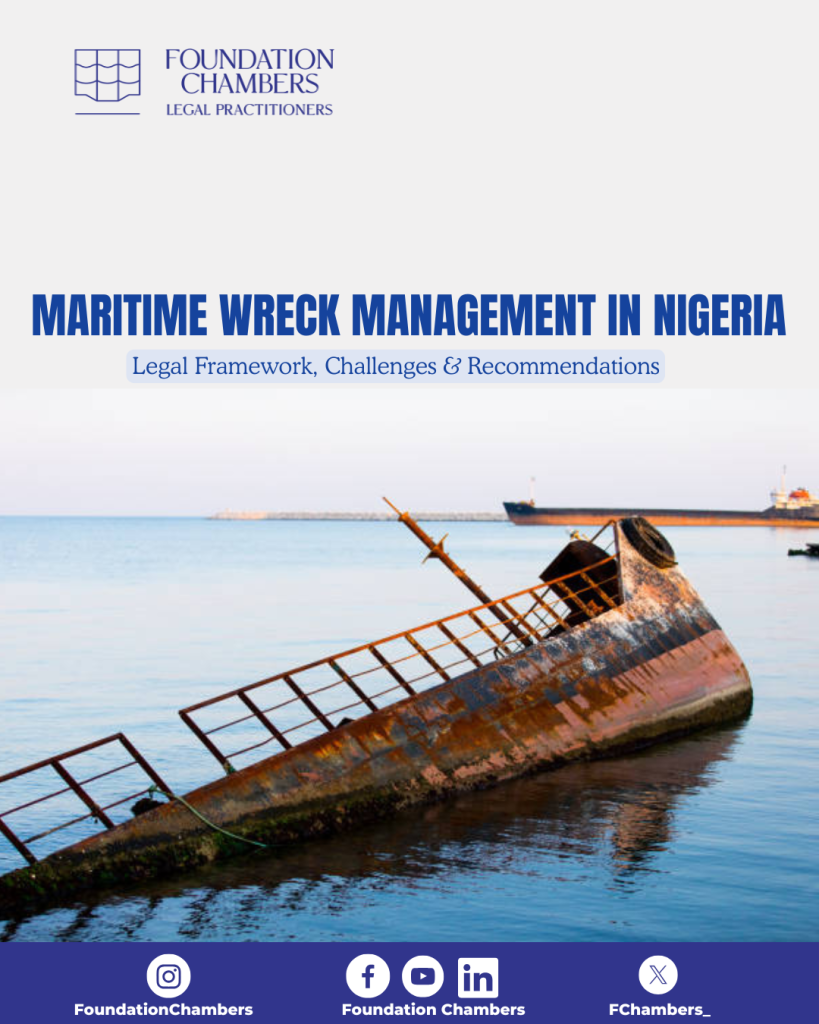
Every year, several vessels meet untimely ends along Nigeria’s vast waterways, leaving behind silent hazards in the form of abandoned wrecks. Wrecks are the remains of a vessel that has been abandoned, yet their impact stretches far beyond the visible debris[1]. These remnants, whether afloat, stranded, aground, or sunken, are hidden threats to maritime safety, environmental health, and the economic lifeblood of coastal communities [2].
The management of wrecks in Nigeria, however, is burdened with legal complexities. Questions and issues concerning which government agency holds authority? Or who is responsible for overseeing salvage operations and protecting the surrounding environment? This paper, therefore, seeks to evaluate the legal framework and governance surrounding wreck management in Nigeria, examine the key challenges impeding effective oversight, and offer practical recommendations for improving the safety, environmental protection, and economic utility of the nation’s maritime spaces.
NIGERIAN LEGISLATION
1. Merchant Shipping Act (MSA) 2007
This Act addresses at length the issue of shipwrecks. Section 361 (2) of the Act defines Wreck as: (a) a sunken or stranded ship, or any part thereof, including anything that is on board such a ship or which is stranded, sunken or in danger at sea and lost at sea from a ship; or (b) a ship that is about, or that may reasonably be expected to become, a wreck by reason of- (i) collision, stranding or any other incident of navigation; or (ii) any other occurrence on board the ship or external to it, resulting in material damage, or imminent threat of material damage, to the ship.
Subsequently, the Act addresses the appointment of Receiver of Wrecks to manage hazardous wrecks, shipowners’ responsibility to remove wrecks and provide financial security, receiver’s powers to intervene, remove, and sell wrecks, penalties for non-compliance, including fines and imprisonment regulations for handling and disposing of wrecked vessels and cargo, protection of marine environment and navigation safety in Sections 360-385 of the Act.
2. Nigerian Maritime Administration and Safety Agency (NIMASA) Act 2007
The NIMASA Act established NIMASA (the Agency) and mandates it to register vessels operating in Nigerian waters and regulate shipping safety, ship construction, and navigation. The Agency is further responsible for search and rescue operations, marine pollution control, and the receipt and removal of wrecks.
Pursuant to Section 22(1)(m), the Agency is empowered to receive and remove wrecks, inspect ships and conduct inquiries into shipwrecks, maritime casualties, and allegations of seafarer incompetence or misconduct, in relation to such casualties.[3] Furthermore, with the approval of the Minister of Transport, the Agency may make regulations for the removal of wrecks that constitute navigational hazards or pose a threat to the marine environment.[4] In exercising these powers, the Agency is required to give effect to Nigeria’s obligations under applicable international conventions and agreements.
3. National Inland Waterways Authority (NIWA) Act 1996
The NIWA Act established NIWA (the Authority) and specifically establishes the scope of its control. Section 1 of the Act provides that all navigable waterways river-ports and internal waters of Nigeria excluding all direct approaches to the ports and all other waters declared to be approaches to ports under the NPA Act, up to 250 meters beyond the upstream edge of the quay of such ports are under the exclusive management and direct control of the Authority. Furthermore, Section 9 further establishes that NIWA shall also have the power to survey, remove and receive derelicts, wrecks and other obstructions on the inland waterways.
4. Nigerian Ports Authority (NPA)Act 1999
The NPA Act established NPA (the Authority) and establishes a broad scope of the Authority’s functions and powers for the regulation of the ports and its general jurisdiction in Section 7. Regarding Wrecks, the Act stipulates that the breaking up and removing wrecks in a port shall be only with the written permission of the harbour master and by providing security as the harbour master may consider reasonable and sufficient to ensure the effective removal of such ship.[5]
INTERNATIONAL CONVENTION
5. Nairobi International Convention on the Removal of Wrecks 2007
The Nairobi Convention, developed by the International Maritime Organization’s (IMO) Legal Committee, is a groundbreaking treaty that establishes strict liability, compulsory insurance, and direct action for wrecks outside coastal states’ territorial waters. The treaty also covers any prevention, mitigation or elimination of hazards created by any object lost at sea from a ship (e.g. lost containers). The Convention provides a sound legal basis for coastal States to remove, or have removed, from their coastlines, wrecks which pose a hazard to the safety of navigation or to the marine and coastal environments, or or both.
LEGAL CHALLENGES & RECOMMENDATIONS
Despite Nigeria having ratified the Nairobi International Convention on the Removal of Wrecks (2007), the Convention has not yet been fully incorporated into the country’s domestic legal system. This incomplete domestication results in enforcement difficulties and ambiguity regarding jurisdictional authority. It is recommended that the Nairobi Convention be domesticated, fully incorporating the Convention into Nigeria’s domestic law to clarify jurisdictional authority and enforcement powers.
Furthermore, it is evident that there are overlapping responsibilities among multiple agencies in Nigeria, including the NIMASA, NIWA and NPA. Each possesses differing and sometimes conflicting powers related to wreck removal, causing bureaucratic delays, confusion, and a lack of coordinated action. streamline agencies responsibilities to eliminate overlapping of responsibilities and bureaucratic delays. For instance, under the Act, the NPA’s Habour Master is responsible for authorising the removal of wrecks, while under the MSA Act, the Receiver of Wrecks manages the removal. It is recommended that the legislators streamline agencies’ responsibilities to eliminate overlapping of responsibilities and bureaucratic delays.
Furthermore, tracking down shipowners of abandoned vessels proves difficult, as many owners leave derelict ships in Nigerian waters to evade disposal expenses.[6] Therefore, legal prosecutions in such cases are rare. It is recommended that the regulatory agencies improve enforcement with stringent fines to discourage negligent conduct or accurate data collection and tracking to facilitate legal prosecution.
There is a deficiency in local technical skills, specialized knowledge, and proper equipment essential for handling complex wreck removal tasks. This shortfall often leads to reliance on external experts or situations where government bodies must cover costs if the vessel owners default[7]. It is recommended that investment be made in building local technical skills and acquiring specialized equipment for wreck removal, reducing reliance on external experts
CONCLUSION
The management of wrecks in Nigeria is a complex issue that requires the collaboration of various stakeholders including government agencies, international organisations and the private sector. With continued commitment, Nigeria can ensure that its waters remain safe, navigable and environmentally sustainable for future generations.
[1] Wreck: A Comprehensive Guide to Its Legal Definition and Context retrieved 23rd January 2026 from https://legal-resources.uslegalforms.com/w/wreck
[2]Marine pollution from sunken vessels retrieved 23rd January 2026 from https://iucn.org/resources/issues-brief/marine-pollution-sunken-vessels
[3] Section 22(2)(b) of the NIMASA Act
[4] Section 44(1)(b) of the NIMASA Act
[5] Section 49 of the NPA Act
[6]Master mariners seek prosecution of shipwreck owners retrieved 23rd January 2025 from https://punchng.com/master mariners-seek-prosecution-of-shipwreck-owners/
[7] Preghafi, A. P. The Law and Challenges of Wreck Removal In Nigeria Waters